


Companies will eventually reach that milestone known as “the rebrand.” For some, it happens early on, once they’ve discovered who they really are, while for others, it occurs after many years of growing (or outgrowing) their brand. And then there’s a new wrinkle in the mix: 82% of consumers now find AI-powered search more helpful than traditional search, yet most rebrands still ignore it entirely, as a key component in their rebrand strategy.
In 2026, that displays a new urgency.
The search landscape has fractured. Your brand isn’t just competing for position one on Google anymore. It’s competing to be the one answer an AI agent recommends when someone asks ChatGPT, Claude, or Perplexity: “What’s the best [your category]?”
HOW TO REBRAND IN 2026: THEN AND NOW
You’ll discover that some brands go along an evolutionary track that one could basically follow.


Others, like GAP back in 2010, made a change that was a disastrous departure resulting in a complete about-face within an eight-day window:
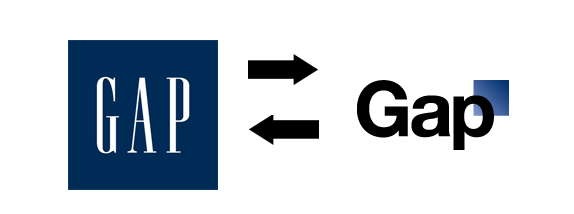
And while a brand is so much more than a company’s logo, the logo is one of the key ambassadors of a brand that we, as customers, all see and recognize. Hence the examples shown above.
But here’s what’s changed: A rebrand used to be about visual identity and market positioning.
Today, to be visible and stay relevant, it’s equally about algorithmic discoverability across fragmented search ecosystems.
Consider Duolingo’s recent rebrand. They didn’t just refresh their visual identity. They optimized their entire brand for how algorithms discover and recommend. Their character-driven, bite-sized content surfaces in voice search, AI-generated recommendations, and social feeds. Their brand became algorithm-friendly. That’s how rebranding will thrive from here on out.

THE NEW VISIBILITY CRISIS
Here’s the reality: 82% of consumers now find AI-powered search more helpful than traditional search. Yet only 22% of marketers are tracking whether their brand appears in LLM responses.
In 2012, your brand was invisible if it wasn’t on Google’s first page. In 2026, your brand is invisible if:
- ChatGPT doesn’t mention you when someone asks for recommendations in your category
- Claude doesn’t cite you in answer summaries
- Perplexity doesn’t include you in synthesized responses
- Google’s AI Overview doesn’t feature your content
- Your brand isn’t discoverable across social search (TikTok, Instagram, Reddit)
This isn’t a secondary concern. This is existential.
A rebrand in 2026 that ignores AI discoverability is like a rebrand in 2012 that ignored mobile optimization; you’re playing catch-up and solving yesterday’s problem.
THE ORIGINAL 19 QUESTIONS: A 15-YEAR LEGACY
Over 15 years ago, I published 19 questions every company should ask before rebranding. Those questions appeared on Google’s Page One for years, and were copied, distributed, and referenced around the world. They became the definitive framework because they addressed the timeless strategic foundation of rebranding.
Those 19 questions are still essential. But the world has evolved.
Which is why I’ve now updated this framework and added 5 new questions specifically for the AI era. Together, these 24 questions form the key reference for the next 15 years.
Here are the foundational 19 questions, as critical today as they were then:
- Why are we doing a rebrand?
- What problem are we attempting to solve?
- Has there been a change in the competitive landscape that is impacting our growth potential?
- Has our customer profile changed?
- Are we pigeonholed as something that we (and our customers) have outgrown?
- Does our brand tell the wrong (or outdated) story?
- What do we want to convey? To whom?
- Why should anyone care about our brand?
- Have we isolated exactly who should care about our brand?
- Have their needs, or the way they define them, changed?
- Are we asking our customer to care more about our brand – and what it means – than we do?
- Is our brand associated with something that is no longer meaningful?
- Is our brand out of step with the current needs and desires of our customers?
- Are we leading with our brand direction?
- Are we following our brand direction?
- Is the goal of this rebrand a stepping stone (evolutionary) or a milestone (revolutionary)?
- Will this solution work in 5, 10, and 15 years from now, based on what we can anticipate?
- Have we assigned some committee to manage the project versus someone (or at most, two people) who is/are focused, inspired, and can lead?
- If we were starting our business today, would this be the brand solution we would come up with?
5 NEW QUESTIONS FOR 2026: THE AI-ERA REBRAND CHECKLIST
Your 19 questions above are still essential. But they’re incomplete without these five new questions that address the transformed discovery landscape:
- Is our brand discoverable when people ask ChatGPT, Claude, or Perplexity for recommendations in our category?
- Does our brand appear in AI-generated answer summaries, or do our competitors own that space?
- Are we optimized for “search-everywhere” – social search (TikTok, Instagram, Reddit), AI agents, AND traditional search simultaneously?
- Do we have structured data (Schema markup) that helps AI understand what we do, who we serve, and why we matter?
- Can voice assistants accurately describe our brand when asked, and does our brand voice translate across platforms?
These aren’t optional. They’re the difference between a rebrand that works and a rebrand that misses the moment.
MORE THAN SKIN DEEP
Use these 24 questions to isolate why you’re rebranding and how to keep your rebrand from the “cliffs of insanity” — that committee-drenched cliché crud being put out by Fortune 100 corporations that have interchangeable brands and message points because they’ve optimized for nothing except avoiding risk.
A great rebrand in 2026 does three things:
1. It’s true to itself. Your brand doesn’t chase trends. It evolves based on who you actually are and what you actually solve.
2. It’s meaningful, so people take notice and care. This means being discoverable where people actually search. Not just Google, but ChatGPT, Reddit, TikTok, and the platforms that reflect culture and where it goes for answers.
3. It’s powerful enough to make the difference everyone hopes for. A rebrand that doesn’t improve your visibility across all search ecosystems (i.e., traditional and AI) is just a new coat of paint.
THE TECHNICAL FOUNDATION OF MODERN REBRANDING
Here’s what separates 2026 rebrands from 2012 rebrands: infrastructure.
Your rebrand must include:
Entity Optimization. Schema markup that connects your brand to Google’s Knowledge Graph and helps AI systems understand your entity, your category, and your relationships.
Structured Content. FAQs, case studies, research, and expert insights formatted so AI systems can parse, understand, and cite you. This is how you become a source AI agents trust.
Multi-Platform Presence. Consistent brand signals across Reddit, LinkedIn, industry publications, and platforms where AI systems pull training data. One-channel brands are invisible to AI.
Citation-Worthy Content. First-party research, original insights, and expert perspectives that AI platforms reference. Generic content doesn’t get cited. Unique perspectives do.
Voice-First Design. Content and brand voice that translates across text, voice search, and conversational AI. Your brand should sound like itself whether someone encounters it on your website, in a voice assistant, or in an AI-generated summary.
Visual Content Strategy. Searchable video with captions and transcripts. AI systems index video content, and captions make it discoverable.
This is the infrastructure of a 2026 rebrand. Without it, you’re rebranding like it’s 2010.
Here’s a recent brand we created that shows exactly how to balance each of these points:
THE REBRANDING PROCESS: 7 STEPS FOR 2026
Most rebrands fail not because of bad design. They fail because there was no process – just opinions, committees, and a logo reveal that solved nothing.
Here’s the process that works. The one responsible for over $9.8 billion in revenue for companies worldwide. And the one that now accounts for the AI era your competitors are ignoring.
Step 1: Diagnose before you design.
Use the 24 questions above. All of them. Honestly. A rebrand without diagnosis is just decoration.
Step 2: Define your identity.
Now you know the noise out there. Now you can look inward to define your identity. Not your tagline. Your identity. I’m going to get slightly technical for a couple of sentences.
Schema markup (this is It is a behind-the-scenes coding that makes your content easy for Google to read), structured data, and a presence in Google’s Knowledge Graph so every AI system that encounters your brand knows exactly what you do and why you matter.
Step 3: Build content AI can extract.
Generic content doesn’t get cited. Original perspectives do. Case studies, first-party research, expert frameworks. These are what AI platforms pull from when synthesizing answers.
Step 4: Establish a multi-platform presence.
One-channel brands are invisible to AI. Your signals need to exist consistently across LinkedIn, Medium, Substack, Reddit, and the publications where AI systems pull training data.
Step 5: Optimize for voice and conversation.
When someone asks ChatGPT, “Who’s the best at rebranding for the AI era?” — what answer comes back? Your brand voice needs to translate across text, voice search, and conversational AI. Not just your website.
Step 6: Launch with infrastructure, not just identity.
The visual identity is the flag. The infrastructure is the flagpole. Entity optimization, structured content, and multi-platform signals go in before the flag goes up – not six months later.
Step 7: Measure AI discoverability, not just traffic.
Traffic tells you who found you. AI citations tell you who’s being told about you. Those are the new metrics of every successful rebrand.
This is the process. Seven steps. No committees. No cliffs of insanity.
The brands that follow it don’t just look different; they leverage their differentiation, their point of view, their “answers” in a world when billions of people are seeking answers online. At the end of the day, your job is to get discovered, cited, and recommended everywhere that matters.
Before you answer these questions, it helps to understand the full philosophy behind what makes a rebrand succeed or fail – including the warning signs that tell you it is time, and the conviction required to see it through. The Brand Strategy Masterclass covers exactly that.
WHY DO CERTAIN BRANDS BECOME GREAT BRANDS?
Great brands in 2026 share something in common: they’re discoverable everywhere their customers search.
They’re not invisible to AI. They’re cited. They’re recommended. They’re the answer people get when they ask an AI agent for help.
But more importantly is connecting on the human level as I explain here:
This is the approach to rebranding that companies need right now to stand out and remain relevant.
Every Saturday morning, David Brier’s newsletter delivers one sharp branding insight you can use immediately — plus, subscribers get the free Lucky Brand framework: 10 steps to build a brand people can’t ignore.
Get the Lucky Brand framework free – subscribe here.

THE BOTTOM LINE
A rebrand is no longer just about visual identity, market positioning, and internal alignment – though those still matter.
A rebrand in 2026 is about ensuring your brand is discoverable, citable, and recommendable across every search ecosystem your customers use.
The companies winning right now aren’t the ones with the prettiest logos. They’re the ones whose brands appear when AI agents synthesize answers. They’re the ones who show up in Google’s AI Overview. They’re the ones customers find when they ask ChatGPT for recommendations.
The original 19 questions served as the definitive rebranding framework for over 15 years. Now, with these 5 additional questions, you have the complete roadmap for the next 15 years.
Use all 24 questions. Answer them honestly. And build a brand that doesn’t just look different – but gets discovered, cited, and recommended everywhere that matters.
Ready to audit your brand’s AI visibility? Most companies don’t realize how much their brand is invisible to ChatGPT, Claude, and Perplexity.
We help you identify exactly where you’re missing in AI search and how to fix it. Get your free AI visibility assessment today with an UNcovery session (where we discuss where your brand is to uncover what’s hiding in plain sight. This is the exact reason it’s not called a discovery session).